
Note: This document reflects industrial experience. The information is provided without any warranty, express or implied, as to its accuracy.
Reviewed by A3TS on July 29, 2026
Principle
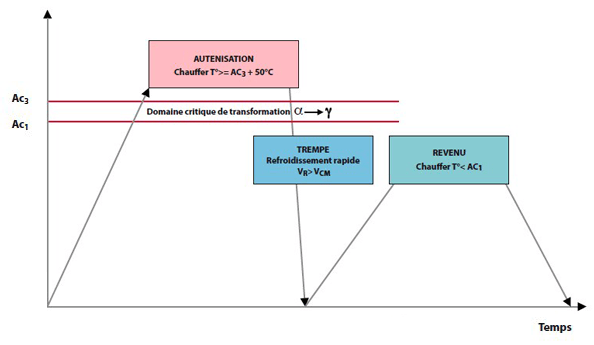
Iron-carbon alloys (steels, excluding so-called austenitic alloys) have the remarkable ability to harden after a heat treatment that involves heating above an austenitizing temperature, ranging from 750 to 1200°C, depending on the composition. At this temperature, the ferrite-pearlite structure transforms into an austenitic structure. Austenitization is followed by quenching, during which rapid cooling allows the austenite to transform into martensite.
Martensite consists of a supersaturated solid solution of carbon in α-iron. Hardness increases with carbon content.
Benefits
Improvement of mechanical properties (hardness, ultimate strength, yield strength).
Wear resistance.
Refining the structure improves impact resistance at low temperatures.
Applications
All mechanical parts subject to high mechanical stress can be hardened.
Limitations
Deformations
Tapures
Quenchability as a Function of Steel Selection and Quenching Fluid
Process Parameters
The austenitizing atmosphere
Austenitization can be performed in various environments: air, an endothermic atmosphere, inert gases (N₂, Ar, H₂), or a vacuum. If the treatment is carried out in air, the surface of the steel undergoes oxidation, forming scale, and decarburization.
The quenching medium
Several cooling media are used depending on the hardenability of the steel, the mass, and/or the geometry of the workpiece or load:
Water.
Oil.
Water and polymers.
Nitrate and Nitrite Salts
Inert gas.
The choice of quenching medium can also be influenced by surface cleanliness criteria. The aggressiveness of the quenching medium affects deformation. Water is the most aggressive medium, followed by oil (cold or hot), water-polymer mixtures, and salt. Inert gas is the least aggressive medium. The temperature of the medium—and particularly that of the oil—affects the cooling rate and the mechanical properties obtained after quenching.
Income
Fragile quenched structures undergo one or more tempering treatments to improve ductility and adjust the hardness levels.
There are two types of income:
Stress relief tempering between 140 and 190°C (240°C max.), hardness after tempering = hardness after quenching - 1 to - 3 HRC
Hardness tempering between 450 and 675°C, hardness after tempering = hardness after quenching - 5 to - 20 HRC
Some high-alloy steels (tool steels) exhibit secondary hardening when tempered in a narrow temperature range. This property is used for hot work applications.
Some alloying elements develop carbides with the carbon: these very hard elements have an effect on hardening. They are partially or totally solubilized during austenitization to participate in the properties and behavior during tempering.
Cryogenic Treatment
Cold treatment (or cryogenic treatment) consists of cooling mechanical parts below room temperature after a quenching heat treatment. The holding temperature is between 0°C and -150°C (most often between -80 and -100°C for steels).
The presence of unstable residual austenite in the structure results from incomplete transformation to martensite during quenching. Residual austenite can decompose during service under destabilizing conditions: high stresses, vibrations, cyclic loading, or operation at temperatures close to the tempering temperature.
Cold treatment will therefore have the effect on steels containing residual austenite:
To increase hardness and yield strength, accompanied by a corresponding decrease in impact resistance and an increase in residual stresses,
To improve the dimensional stability of parts. It is therefore particularly recommended for gauges and components with very tight clearances.

Steels for through-hardening
The carbon content determines the maximum hardness after quenching.
Additive elements improve hardenability (hardness depth) and reduce the loss of hardness during tempering. Steels for through-hardening are specified in the NF EN ISO 683-1 and NF EN ISO 683-2 standards.
Implementation
Main equipment (furnace, reactor, line, machine...)
Additional equipment (washing, degreasing, pickling, finishing, handling)
Ancillary equipment (pumps, turbines, resistances, burners, quenching tanks, filters, exchangers, refractories...)
Process control and monitoring ( pyrometry, atmosphere analyzers and probes, automatons, regulators, recorders...)
Energy and fluids (gases, chemicals, quenching liquids, salts...)
Tools and handling (assemblies, baskets, trays...)
Control of the result (hardness test, mechanical test, metallography, NDT, thickness measurement...)
Application materials (steels, cast iron, titanium alloys, aluminum alloys...)
If you are a company interested in being listed on this page, please contact us: a3ts@a3ts.org