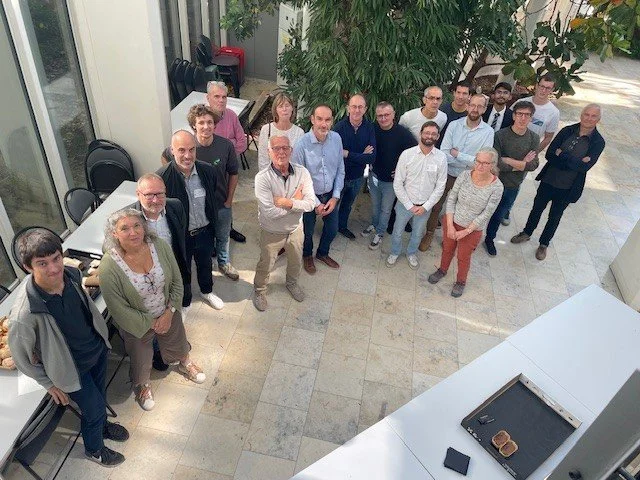
The technical seminar at the CRM Group in Liège was attended by twenty-five people and focused on the topic “Microstructural Characterization of Materials.”
The day began with a creative and humorous presentation on the relationship between microstructure and mechanical properties of metallic materials and their alloys. The discussion then turned to metallographic preparation techniques, which allow for surface treatment without causing deformation or structural changes, while reducing polishing time and minimizing environmental impact. The use of basic reagents and their practical applications were also reviewed.
In terms of characterization equipment, the benefits of digital microscopy were highlighted, particularly its large depth of field, which facilitates the observation of porosity and surface defects. Brightfield and inverted-field (darkfield) illumination, meanwhile, make it possible to highlight specific features of the sample.
The intersection of metallurgy and archaeology has highlighted the importance of SEM and EDS analyses in identifying the precise nature of an alloy and determining its age. Methodological rigor is essential when using SEM, and the integration of statistical methods helps ensure the reliability of metrological measurements. The new generation of SEMs has established itself as a true multi-purpose tool combining metrology, FIB, EDS, and EBSD, while complementing optical and X-ray microscopy. At the macroscopic scale, X-ray diffraction (XRD) is applied to crystalline phases to measure interplanar and interatomic distances, thereby providing the material’s unique atomic signature.
Finally, 3D imaging methods were presented using tomography, with an analysis of its benefits and limitations. A comparison between a laboratory tomograph and a synchrotron highlighted tomography as an accessible solution for non-destructive analysis of internal structure.